
Safe Passage Via Coordination
The ceasefire didn’t dismantle the system. It named it.

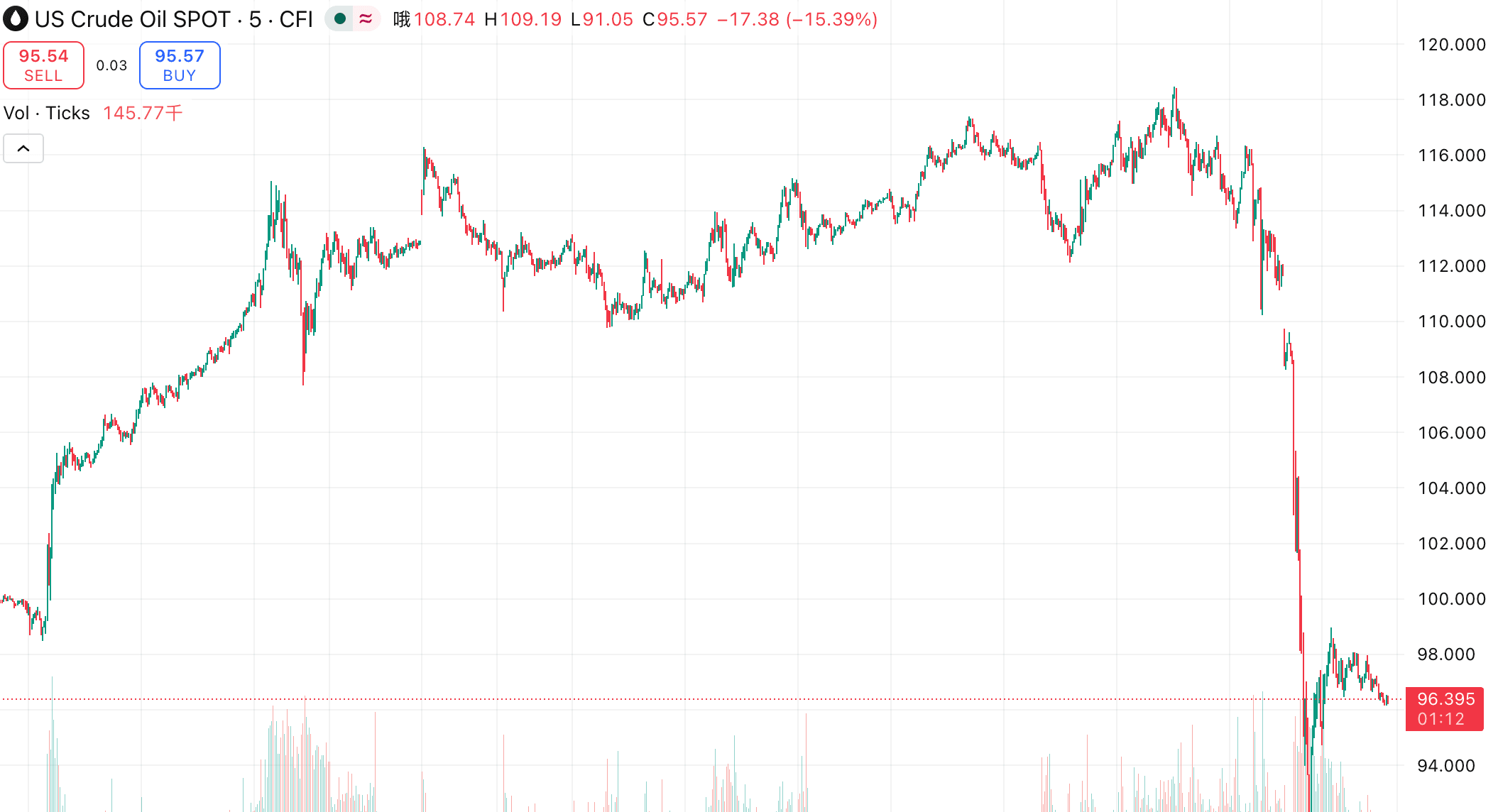
Brent crude’s relief plunge after the ceasefire announcement. Markets reacted to the pause; the physical system (backlog + broken pipes) did not.
Oil crashed 17%. Markets surged. Headlines declared the crisis over.
Then look at the fine print. Iran’s Foreign Minister Abbas Araghchi announced that “safe passage through the Strait of Hormuz will be possible via coordination with Iran’s Armed Forces and with due consideration of technical limitations.”
The ceasefire didn’t reopen the strait. It formalized who controls it.
The Dig
What “Coordination” Means
The phrase doing all the work is “coordination with Iran’s Armed Forces.”
This is not a return to pre-war transit. Under the UN Convention on the Law of the Sea, the Strait of Hormuz is an international waterway subject to transit passage rights. Coastal states cannot impose fees or require coordination for passage through international straits.
Iran signed UNCLOS but never ratified it. The war created the leverage to test what happens when a non-ratifying state simply asserts control. The ceasefire operationalizes that test.
Al Jazeera, citing AP, reported that the ceasefire plan allows for Iran and Oman to charge fees on ships transiting the waterway, with Iran’s revenue designated for reconstruction. The White House contradicted this within hours. Press Secretary Karoline Leavitt said Trump wants the strait opened “without limitation, including tolls.”
The gap between what Iran announced and what Washington expects is the gap the next two weeks will test.
The IRGC vetting system that screened vessels for ownership, insurance, and Israeli affiliation throughout the war is still running. The corridor north of Larak Island is still the only route. The toll legislation Iran’s parliament passed on March 31 is still on the books. None of this was dismantled by the ceasefire. The word “coordination” legitimized it.
The system is already built. The deadline is asking Iran to dismantle it. If this system survives into whatever comes next, the question of who controls Hormuz shifts from a legal abstraction to an operational fact. The ceasefire didn’t clear the backlog. It created a two-week proof-of-concept for Iran-managed transit.
The Math the Markets Ignored
The numbers tell a different story than the price charts.
According to CNN, citing Kpler analysis, approximately 1,000 ships remain backlogged, with roughly 80% still stranded inside the Persian Gulf. Before the war, this volume would have transited in 7-9 days.
The constraint isn’t the strait. It’s the system controlling it.
Throughput under Iranian coordination is 10-15 vessels per day. At current throughput, 150-210 ships transit in two weeks. 800+ ships remain when the clock runs out.
Lloyd’s List’s editor-in-chief Richard Meade told CNN that shippers “don’t have the details from Iran” and “believe the system that was in place at midnight has not changed despite the announcement of the ceasefire.” The vetting process remains intact: ownership, management, insurance, financing, charter history, any affiliation to the United States or Israel.
Maersk’s statement was even more direct: “The ceasefire may create transit opportunities, but it does not yet provide full maritime certainty.” They are not changing any services. They are waiting.
Windward’s maritime intelligence daily for April 8 tracked the first post-ceasefire movements. Five bulk carriers were observed outbound as of noon, all confined to the IRGC-controlled corridor. No blue-chip operators. No major oil majors. The profile matches the risk-tolerant operators who transited throughout the war, not a return of mainstream commercial shipping.
Insurance coverage for war-risk exclusions remains a blocking constraint. The vessels moving are the ones that were already willing to move.
The Bypass Got Hit
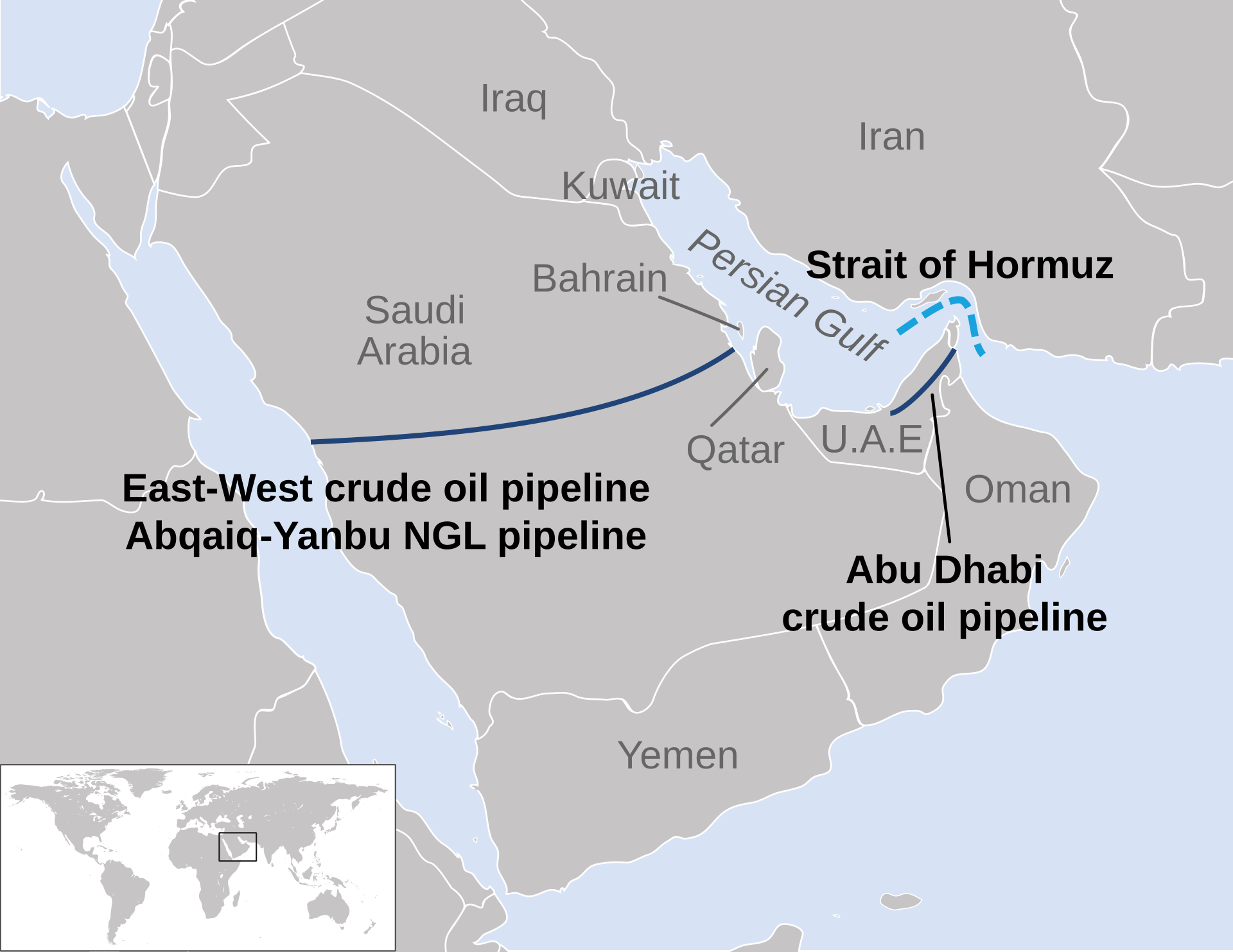
Saudi Arabia’s East-West Pipeline (Petroline) became the primary Hormuz bypass. The April 8 drone strike on a pumping station shows the alternative route is not outside the conflict.
Hours after the ceasefire announcement, a drone struck Saudi Arabia’s East-West Pipeline.
Bloomberg reported that the attack targeted a pumping station along the 1,200-kilometer Petroline, which carries crude from Saudi Arabia’s Eastern Province to Yanbu on the Red Sea coast. The pipeline had become Saudi Arabia’s primary export route after shipping through Hormuz was throttled.
The damage was reportedly limited and contained. The pipeline was not shut down. But the timing was precise.
This is the Second Valve principle from Edition 14. When a crisis forces traffic onto an alternative route, that route becomes a target. The East-West Pipeline was the bypass. Now it’s been struck on the same day the ceasefire was announced.
The 2019 Abqaiq attack proved the pipeline system was targetable. The April 8, 2026 strike proved it remains targetable even during a ceasefire. The assumption that the bypass corridor existed outside the war no longer holds.
Broken Pipes Don’t Unblock
Nothing that happened Tuesday night changes the physical damage at South Pars.
IATA’s director general Willie Walsh said Wednesday that it will take “months” for jet fuel supplies and prices to normalize even if Hormuz remains open. “I don’t think it’s going to happen in weeks,” Walsh told reporters. The constraint is “the disruption to the refining capacity in the Middle East.”
The second Israeli strike on South Pars, on April 6, hit the Jam and Damavand petrochemical facilities plus the Mobin and Damavand utility companies. Cumulative production losses across both strikes approach 85% of Iran’s petrochemical capacity.
Markets priced the ceasefire as resolution. What actually happened: the bombing stopped, the strait partially reopened under Iranian terms, and the broken infrastructure remained broken.
Brent crude dropped from $110 to around $91-94 on Wednesday. CNBC reported this was WTI’s worst daily performance since April 2020. The geopolitical risk premium unwound in hours.
But the physical reality takes longer. The backlog clears slowly. The refineries don’t rebuild in two weeks. The bypass just got hit.
What the Islamabad Talks Actually Test
This is the next phase of the Deadline Ratchet.
The negotiations begin Saturday in Islamabad. Vice President Vance, special envoy Steve Witkoff, and Jared Kushner will lead the U.S. delegation. Pakistan brokered the ceasefire and is hosting the talks. Iran’s 10-point proposal remains the framework Trump called a “workable basis” for negotiation.
That proposal, as reported by NBC News, includes:
“Controlled passage through the Strait of Hormuz coordinated with Iran’s armed forces”
“Establishment of a secure transit protocol in the Strait of Hormuz, ensuring Iran’s control under the agreed framework”
Withdrawal of U.S. combat forces from all regional bases
Lifting of all sanctions
Full payment of Iran’s war-related damages
The first two points formalize exactly what the ceasefire already established. Iran’s proposal does not ask for the pre-war status quo. It asks for recognition of the new one.
Both sides claimed victory Tuesday night. Iran’s Supreme National Security Council said “nearly all war objectives have been achieved.” Defense Secretary Hegseth said “Iran begged for this ceasefire” and “we achieved every single objective.” Both statements can’t be true on the same terms. But both can be true if each side is measuring against different objectives.
The U.S. objective, as stated repeatedly, was the complete and unconditional reopening of the Strait of Hormuz. What they got was conditional reopening under Iranian coordination for two weeks.
Iran’s objective, based on its actions throughout the war, was to establish leverage over Hormuz that survives the fighting. What they got was a ceasefire that leaves their administrative system intact while negotiations continue.
The Islamabad talks determine whether this system becomes permanent or temporary.
The constraint on this analysis: the ceasefire is 18 hours old. The first vessels are moving. The system could collapse, harden, or evolve. What we know is what the language says. “Coordination with Iran’s Armed Forces” is not freedom of navigation. The vetting process is still running. The bypass just got struck. And 800 ships are still waiting to see which version of the strait they’ll transit through.
The ratchet didn’t reverse. It entered a new phase.
The Grade Report
Three Pressure Points This Week
01 | The backlog won’t clear in two weeks
At 10-15 ships per day under Iranian coordination, only 150-210 vessels transit before the ceasefire expires. Roughly 800 ships remain stuck. Kpler analyst Ana Subasic told CNN the math is straightforward: pre-war, this backlog would clear in 7-9 days. Under the current system, it extends well beyond the two-week window. The ceasefire creates a proof-of-concept, not a resolution.
02 | The East-West Pipeline got hit on ceasefire day
Hours after the announcement, a drone struck a pumping station along Saudi Arabia’s Petroline. Damage was limited. The pipeline was not shut down. But the timing demonstrated that the bypass corridor is not outside the war. The 2019 Abqaiq strike was a proof of concept. This was its operational maturation, delivered on the day Saudi Arabia expected to resume Red Sea exports.
03 | Israel says the ceasefire doesn’t cover Lebanon
Netanyahu confirmed Wednesday that while Israel will comply with the Iran ceasefire, it does not extend to Lebanon. Israeli strikes continued Wednesday morning near Tyre. Pakistan’s prime minister said the ceasefire does cover Lebanon. The contradiction is unresolved. Iran said it stands with Hezbollah “with all might.” If Lebanon becomes the channel for continued escalation, the ceasefire’s scope becomes its first test.
The headlines show you the event. The system tells you the truth.
J. Miller
35 years in public infrastructure. Now writing about the systems nobody sees.